Litigation Funding Disclosure Moves Into the Policy
Verisk calls third-party litigation funding a "main catalyst" for social inflation,1 and EY has estimated it could cost the industry up to $50 billion over the next five years.2
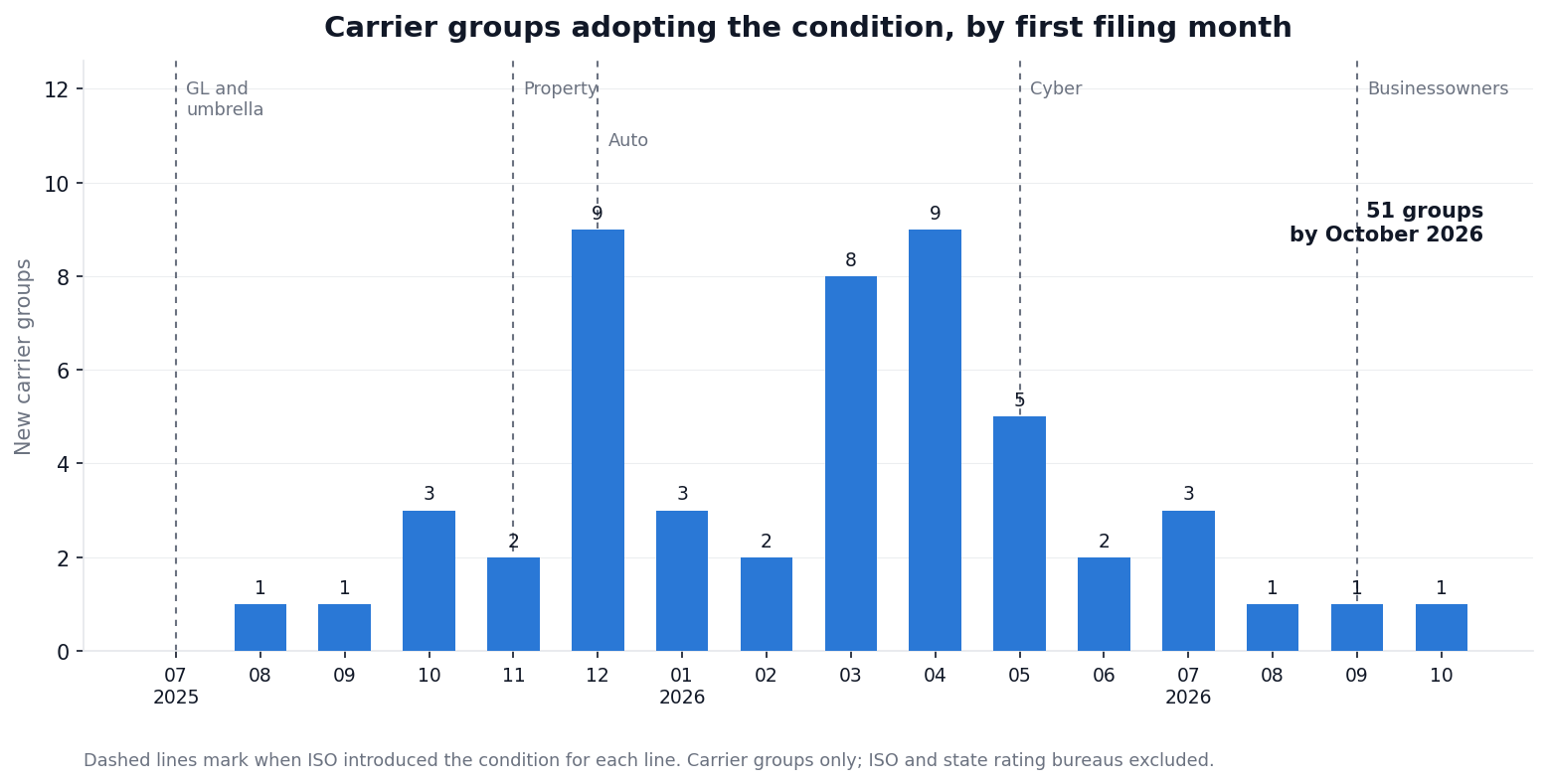
Before 2025, no policy condition dealt with it. In July 2025, ISO introduced a condition that does, first for general liability and umbrella policies. More than 50 carrier groups have since adopted it, and ISO has extended it to commercial auto, property, cyber and businessowners.
The condition is short, optional and carries no premium. Seven states have pushed back on it.
What the condition says
ISO introduced the language as CG 99 11 01 26, Condition - Litigation Funding Mutual Disclosure, effective January 2026. The trigger is a coverage disagreement:
If we and an insured do not agree whether or to what extent a claim or "suit" is covered by this Policy, either party may make a written demand for mutual disclosure of any "third-party litigation funding agreement(s)" regarding that claim or "suit".
Once a demand is made, each side has 30 days to state in writing whether it or its attorneys have signed a funding agreement. If so, it must hand over a copy, name the funders, say whether a funder must approve or be consulted on litigation or settlement decisions, and describe the funder's financial interest. Updates are due within 30 days of any change.
The same wording followed in other lines:
| Line | Form | Introduced |
|---|---|---|
| General Liability | CG 99 11 01 26 | July 2025 |
| Umbrella and Excess | CU 99 02 01 26, CX 99 02 01 26 | July 2025 |
| Commercial Property | CP 99 14 06 26 | November 2025 |
| Commercial Auto | CA 05 34 09 26 | December 2025 |
| Cyber | CY 20 84 04 27 | May 2026 |
| Businessowners | BP 18 46 03 27 | September 2026 |
What it is trying to solve
Third-party litigation funding is outside capital invested in a lawsuit in exchange for a share of the recovery. State legislation and the proposed federal court rule are both aimed at one scenario: a plaintiff, or the plaintiff's law firm, backed by an undisclosed investor who has a stake in the outcome and sometimes a say in whether the case settles. The defendant in that case is often a policyholder, and the carrier is the one deciding whether to settle.
A policy can only bind the parties that sign it. Verisk says it developed the condition with the National Association of Mutual Insurance Companies (NAMIC). Much of NAMIC's work on litigation funding is legislative and regulatory advocacy, and its staff "identified the language of insurance contracts as another potential vehicle to bring fairness to the litigation process." Verisk describes the result as doing for "certain insurance coverage-related lawsuits" what some states do by requiring disclosure of funding agreements.1
What the condition reaches
The condition runs between the carrier and the insured. When the two disagree on coverage, each discloses its own funding agreements to the other. A claimant suing the insured is not a party to the policy and has no duty under it.
| Policy condition | State disclosure laws | Proposed federal rule | |
|---|---|---|---|
| Who discloses | The carrier and the insured | Usually the funded party. In some states the funder or attorney, to the attorney general | Any party to a federal civil case |
| Trigger | A coverage disagreement, with or without a lawsuit | A lawsuit in most states. A claim in Montana | Initial disclosures in a federal case |
| Reaches a claimant's funder | No | Varies by state | Yes |
| Applies to a coverage suit between carrier and insured | Yes | Varies by state | In federal court, if adopted |
| Source of the duty | The insurance contract | Statute | Court rule |
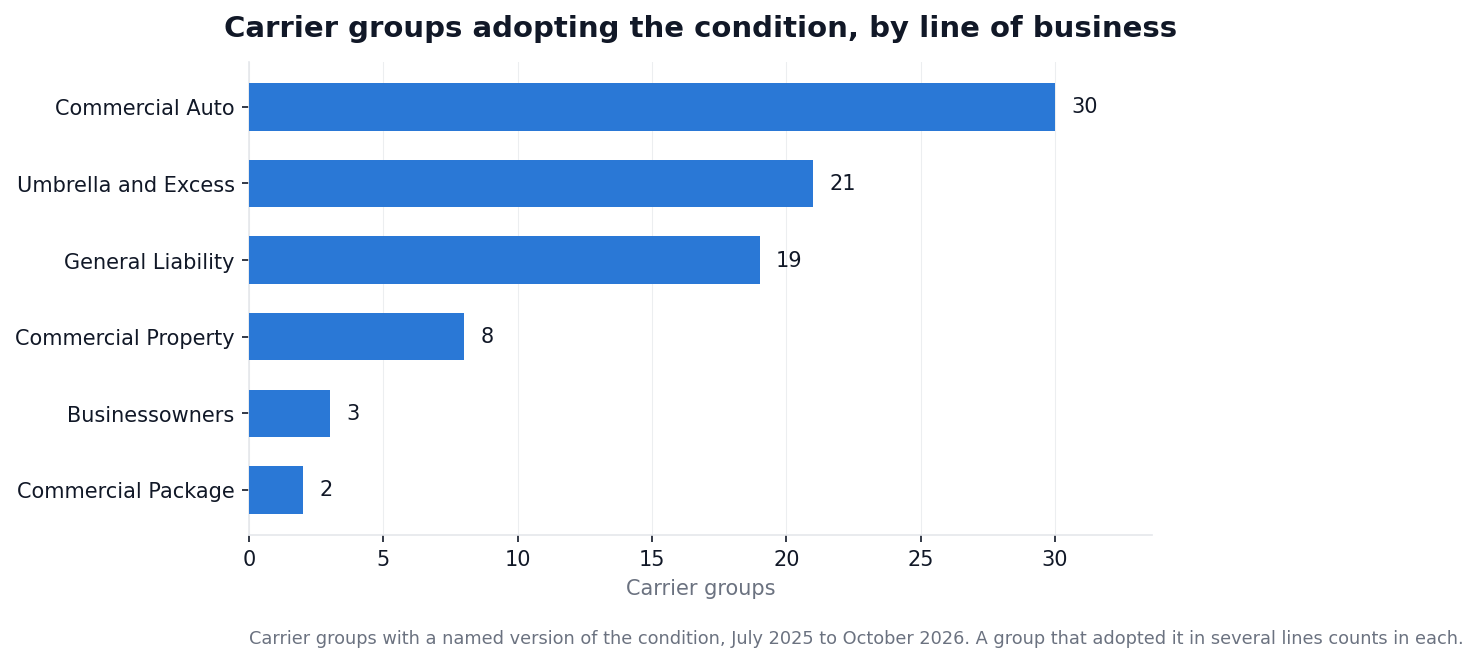
That narrows where the condition applies in practice. An insured is most likely to be a funded claimant on property and cyber policies, and on uninsured motorist claims under commercial auto. Property and cyber account for a small share of adoptions. Most are in commercial auto, umbrella and general liability, where the insured is usually the defendant and funders rarely back defendants.
The rules moving alongside it
State funding laws
Verisk counted 34 litigation funding bills proposed and another 7 enacted in 2025 through October, up from 9 proposed and 4 enacted in 2024.1 The laws make the funded party reveal the funder to the other side, limit what the funder can control, cap the funder's recovery, or require the funder to register and show where its money comes from. As the U.S. Chamber put it when Montana's law passed, "defendants, judges, and often even plaintiffs don't know if a case has outside funding."3
Montana's 2023 law, amended in 2025, does all four. Funders register with the Secretary of State, their share of a recovery is capped at 25%, and they are jointly and severally liable for costs and sanctions. A funded party must deliver the contract, without waiting for a discovery request, to every party, the court, and any insurer obligated to defend or indemnify a party. The duty applies whether or not a lawsuit has been filed.4 Ohio's 2026 law bars funding from anyone not domiciled in the United States, keeps funders out of strategy, settlement and the choice of counsel, and requires lawyers to report funding agreements to the attorney general after a case is resolved.5 North Carolina went furthest in June 2026 with an outright ban: funding contracts are void, with civil penalties up to $50,000 per violation.6
Kentucky's champerty law, carried into the code in 1942 from an older statute, voids agreements that give a nonparty part of what is sued for in return for aiding the suit. The Kentucky Department of Insurance cited it when it rejected the condition.7
Federal rule
Defendants in federal cases have had to disclose their liability insurance since 1970, on the reasoning that the insurer "takes control of the defense" and settlement, so the other side should know it is there.8 The proposal before the Advisory Committee on Civil Rules asks for the mirror image: a plaintiff must disclose any nonparty funding the action. In September 2026, 214 companies signed a letter supporting it, including AIG, Chubb, State Farm, Liberty Mutual, Nationwide, Travelers, Allstate and Zurich. The letter describes the problem as it plays out at the settlement table: "the settlement process often unravels when the nominal plaintiff or its counsel needs to obtain approval from undisclosed non-party funders or uses the non-party as an excuse to retract a commitment to settle."9 The committee took up the subject on October 21 and has not decided whether to pursue a nationwide rule.10
Who adopted it
Adoption came in waves that track each line's introduction. Early trade coverage did not pick up the first wave. A December 30, 2025 report said large insurers had not announced plans to adopt the provision.11 By that date 14 carrier groups had already filed it.
Great American, AXA XL, Liberty Mutual and AIG have adopted it most widely, each in 39 or more states, with Intact close behind. State Farm, Allstate, Zurich, CNA, Chubb, Nationwide, Hartford and Travelers have adopted it in at least one line. Some carriers declined specific versions: Selective adopted the umbrella condition but not the property one, and Hanover's NOVA Casualty also passed on the property version.
Nearly every carrier treats it as optional. None attaches a premium charge, credit or rating factor to it. Great American's adoption states the endorsements "are optional and there is no rate impact." Regulators noticed. Pennsylvania asked one carrier to "explain why no premium consideration is necessary and the circumstances on when the endorsement would apply."
How states responded
The general liability and umbrella versions moved through most states with little comment. ISO told New Jersey in May 2026 that the condition had been submitted in 53 jurisdictions and implemented in 45. Scrutiny arrived with the property, auto and cyber versions, and with carriers' own adoptions in early 2026. The states that pushed back did so in two different ways. Kentucky, Texas and California objected to ISO's own filings. Texas and California have left the general liability version pending since 2025, and Kentucky rejected the property version. Connecticut and Illinois approved ISO's versions in 2025 and objected only when carriers filed their own adoptions the following spring.
| State | Position | Outcome |
|---|---|---|
| Kentucky | The insurer would use it "to request information not relevant to the risk, a claim, or the insurance policy itself." The Department added that "the only function this endorsement serves is to penalize an insured's failure to comply by refusing to pay a valid claim." | Property version withdrawn. Several carriers filed Kentucky exceptions removing it, while umbrella versions from AXA XL, Liberty Mutual and Nationwide were approved in 2026. |
| Texas | "Please remove this provision." A funding agreement "could qualify as work product," and "a court is the appropriate forum." | Property version withdrawn. General liability and auto pending. |
| California | The condition "does not adequately address California law protections for attorney-client privilege, work product doctrine, and confidentiality provisions." | Property, auto and cyber versions withdrawn. General liability and umbrella pending. Nothing is in use. |
| Connecticut | Asked why the form revises policy conditions "as opposed to treating the form as a simple disclosure," and whether a carrier would cancel or non-renew an insured who refused. | AIG and AXA XL withdrew the condition. |
| Illinois | Asked "what is the purpose of allowing either party to demand disclosure?" Then found it contrary to the Illinois Consumer Legal Funding Act. | Nationwide, Liberty Mutual, AIG and others withdrew between July and October 2026. ISO withdrew its own general liability, umbrella and auto versions effective January 1, 2027. |
| New Hampshire | Asked carriers to withdraw "as there is legislation pending on this topic." | Great American, Liberty Mutual and Intact withdrew. |
| Virginia | "The Code of Virginia does not require insureds to release this information. As such, this form must be withdrawn." | Businessowners version blocked after general liability, umbrella and auto were approved. |
| Oklahoma, Kansas, District of Columbia | Asked how the condition is enforced, for "real life examples of how this form will be used," and how it interacts with confidentiality clauses. | Approved after responses. |
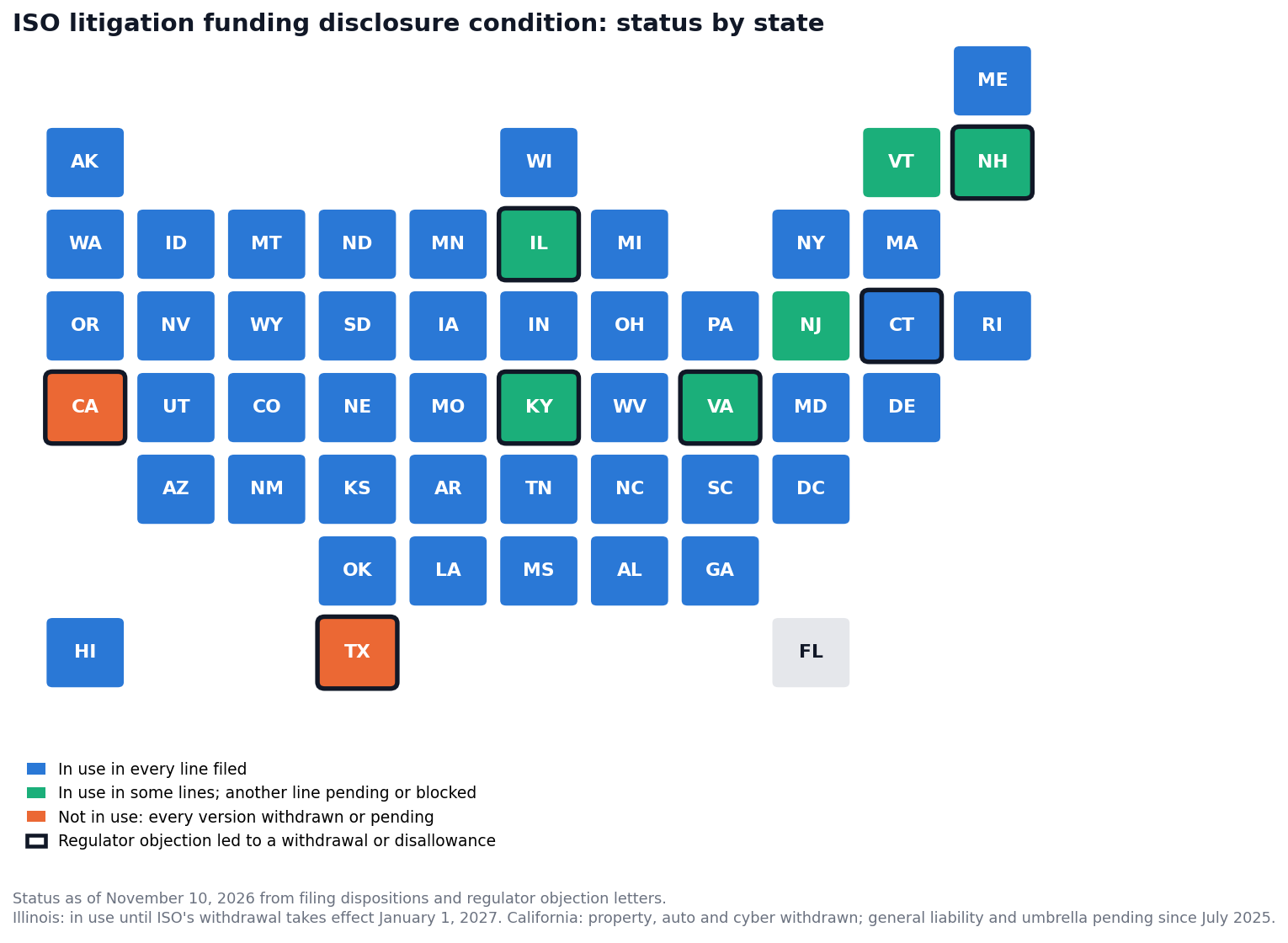
The objections center on privilege and work product, on whether a disclosure duty belongs in a policy condition, and on whether the information bears on the risk at all. Shortly after the condition was introduced, policyholder counsel argued that disclosure should not be a condition of coverage,12 and a litigation funder argued the condition could not be enforced.13 Neither raised privilege or work product, which appear in the regulators' letters.
ISO has not revised the condition in response. Outside Illinois, every version remains at its original edition.
Data sourced from FilingFocus.
Footnotes
-
Verisk, "Increasing Third Party Litigation Funding Transparency From an Insurance Industry Perspective" (January 22, 2026) ↩ ↩2 ↩3
-
Claims Journal, APCIA support for federal litigation funding legislation (January 13, 2026) ↩
-
U.S. Chamber of Commerce, "Montana Enacts Legislation to Require Mandatory Disclosure of TPLF" (May 4, 2023) ↩
-
Montana Code Annotated 31-4-101 to 31-4-125, Litigation Financing Transparency and Consumer Protection Act ↩
-
North Carolina Session Law 2026-14, House Bill 315 (June 22, 2026) ↩
-
Kentucky Revised Statutes 372.060, Champertous contracts and conveyances void ↩
-
Lawyers for Civil Justice and U.S. Chamber Institute for Legal Reform, Rule 26 suggestion to the Advisory Committee on Civil Rules (2026) ↩
-
Letter from 214 companies to the Advisory Committee on Civil Rules, Rule 26 and third-party litigation funding (September 14, 2026) ↩
-
MLex, "US Judicial Conference remains undecided on litigation funding disclosure" (October 21, 2026) ↩
-
Bloomberg Law, "Insurers' Fight With Litigation Funders Hits Liability Policies" (December 30, 2025) ↩
-
Hunton Insurance Recovery Blog, "ISO Approves New Litigation Funding Disclosure Condition Endorsement" (November 5, 2025) ↩
-
Omni Bridgeway, "ISO's 'Litigation Funding Mutual Disclosure' Is Unenforceable" (January 27, 2026) ↩