Insuring the AI Data Center Boom
New U.S. data-center construction projects totaled $98.5 billion through August 2026, already more than all of 2025 and about 120% above the roughly $45 billion recorded by the same point last year. That 2025 figure was itself about 165% higher than the same period in 2024.1
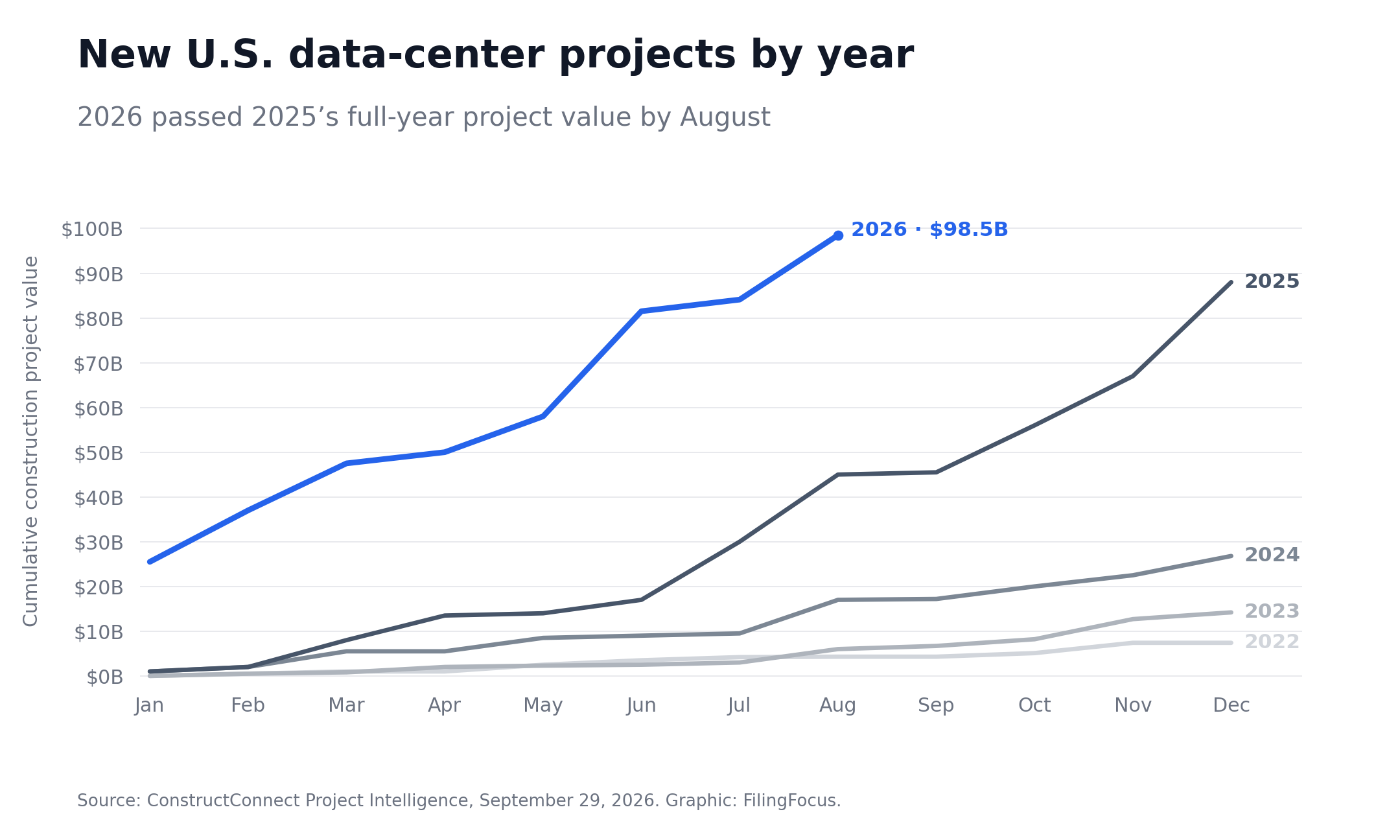
These figures cover the whole data-center market, not just AI, but AI is a major driver of the acceleration. Equipment, power and cooling exposures are growing with it.
Colossus 1 in Memphis shows how quickly that exposure can accumulate. xAI brought its initial 100,000-GPU cluster online in 122 days and reached 200,000 GPUs by February 2025. Samaritan Research estimates the facility’s capital cost at $12.9 billion, with 340 megawatts of IT power capacity.2
Colossus 2 goes further. Samaritan Research’s July 2026 assessment put its capital cost at $35.8 billion and projected $58 billion by the first quarter of 2027, with roughly 1.5 gigawatts of IT power capacity. That is more than four times its estimate for Colossus 1.3
Swiss Re’s September 2026 outlook projects cumulative data-center investment above $6 trillion by 2030 and a related global insurance premium opportunity of $91 billion by the end of the decade.4 That opportunity spans construction, operations and the businesses that depend on these facilities. The challenge is deciding how much of the risk familiar policies can absorb, and where coverage needs to change.
What is changing about the risk?
More value exposed to the same event
Fire, flood and electrical faults are familiar to property insurers. What changes is how much expensive computing, cooling and power equipment sits at one campus when they happen.
Allianz Commercial’s August 2026 analysis of roughly $800 million in data-center claims found that fire accounted for well over half the loss value. Water damage was the most frequent cause, and business interruption was the largest source of severity by line.5 That is one claims sample rather than an industry loss rate, but it shows why building value alone understates the exposure.
Concentration also extends beyond a single insured. Aon’s August 2026 research highlights campuses and regional clusters that share utilities, suppliers and other infrastructure, so one event can trigger claims across several facilities and policies.6 Capacity written for an owner, its contractors and its customers may all be exposed to the same loss.
Power and cooling become business dependencies
Power is both a construction constraint and an operating requirement, and cooling has to work alongside it. An outage can stop computing services even when physical damage is limited, and a cooling failure can damage equipment and bring claims from tenants.
Zurich’s 2026 risk research describes how a small fire can force cooling systems offline, widening the business interruption loss.7 Its October commentary also points to the small pool of specialist contractors working across power, cooling and water infrastructure.8
Reliance on outside utilities, cloud providers and specialist contractors creates third-party risk. Each dependency raises a different coverage question. Damage to a transformer, a delayed grid connection, negligent cooling design and a missed uptime commitment do not necessarily trigger the same policy. Adding property limits does not solve all four.
Construction and operations overlap
One hall may be serving customers while another is being commissioned and a third is still under construction. A contractor’s error can damage an operating area, and an operating failure can disrupt unfinished work.
That makes the project’s overall completion date less useful than the status of each phase. Testing, acceptance, occupancy and permanent insurance placement can each change which policy responds, which is why insurers and brokers are now addressing the construction-to-operations handoff directly.
One incident can produce several different claims
A single cooling failure can damage an owner’s equipment, interrupt a tenant’s business, prompt a service claim against the operator and lead to a negligent design allegation against an engineer. The owner’s property damage and lost income are first-party losses; claims against the operator or engineer raise third-party liability questions. Contractual obligations, technology E&O and professional liability each need to be considered, even when the claims share a cause.
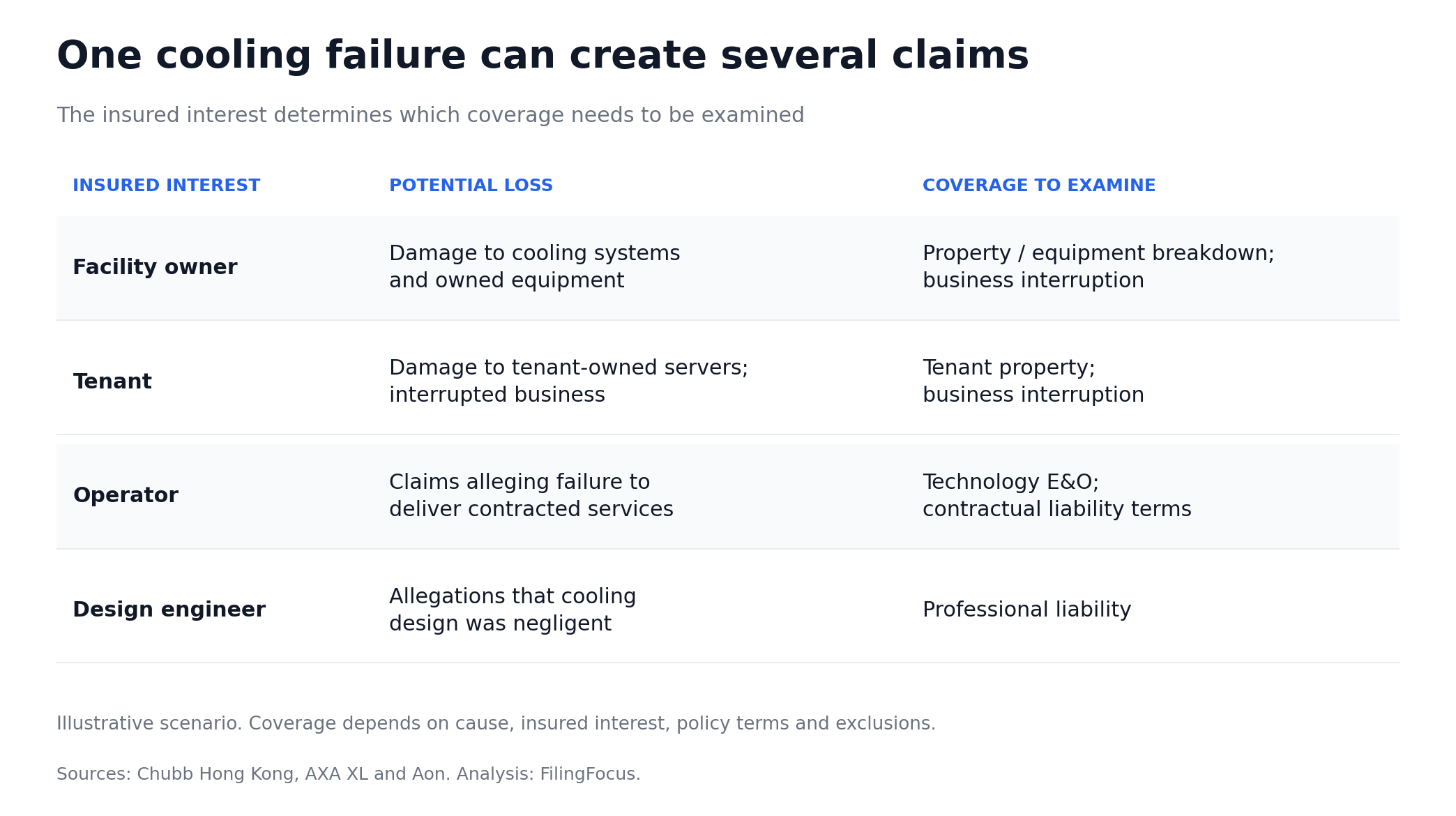
Illustrative analysis. Each response depends on the insured, cause of loss, policy terms and applicable exclusions.
How insurers are responding
Zurich: extending construction protection into early operations
Zurich announced Data Center Project Guard in December 2025, available for new U.S. projects from January 1, 2026 on a project-specific, non-admitted basis.9
It adds up to 12 months of operational property coverage to support phased handovers, potentially including business interruption. It also addresses climate-control system failure, supplier locations, transit and off-site storage or assembly. A weather-parametric feature, included automatically for the first year of construction, covers specified delays that involve no physical damage.
That matters because extending a construction policy is not the same as expressly covering operations or providing a delay trigger without physical damage. Zurich’s announcement targets both, though the issued wording, not the marketing description, will determine what responds.
AXA XL: coordinating existing lines around the project
AXA XL’s October 14, 2026 article, Building North America’s Digital Backbone, describes a coordinated approach across builders risk, subcontractor default, casualty, professional liability and environmental insurance.10
It ties the insurance to the project’s engineering: power-system design, specialist subcontractors, fuel and battery exposures, and the consequences of failing to deliver promised capacity. Rather than one new data-center policy, it is a program assembled across several lines.
That puts more weight on how the policies fit together. A professional liability grant for a design error answers a different obligation than the owner’s property and business interruption cover, yet both can apply to the same loss.
Chubb: a dedicated data-center proposition across the lifecycle
Chubb’s Insurance Solutions for Data Centres, published in Hong Kong in February 2026, targets colocation and hyperscale facilities.11 The suite spans Construction All Risks and Delay in Start-Up, cargo and construction liability, professional indemnity, environmental impairment liability, and operational property and business interruption. PremierTech adds technology E&O, general liability and cyber.
The factsheet’s scenarios, including commissioning fires, cooling-design failures, backup generator emissions and service interruptions, illustrate why several lines are involved. They are examples, not a statement that every resulting cost is covered, and they describe Hong Kong products rather than U.S. wording.
CEO Evan Greenberg also cited builders risk, operational property and engineering among Chubb’s global data-center capabilities in early 2026, while cautioning about energy availability, labor, supply chains and how many announced projects will actually be built.12
Brokers are also addressing the transition
In September 2026, Lockton announced a Builders Risk & Property Program for data centers with insurer partners, built specifically around phased development and the move into operations.13 Alongside the carrier examples, it shows the handoff becoming part of what is marketed, rather than a gap left between separate placements.
Filed wording shows both expansion and limits
Announcements describe intent. Filed forms show the actual terms. We searched FilingFocus for data-center, cloud and AI language across filed forms, then read each endorsement alongside its filing history. The results show insurers both adding protection and drawing explicit boundaries.
Some changes protect the businesses that buy cloud and AI services rather than the operator’s buildings, a distinction that matters when judging what “data-center coverage” actually covers.
HSB’s Google Cloud Protection endorsement (HTC GCP 12 2025), filed in California in February 2026 and approved in August, adds business income and extra expense coverage for specified unplanned Google Cloud outages. It defines an outage as an “unintentional or unplanned total or partial interruption or unavailability of Google Cloud Services.” Google AI services fall within the services definition, and routine maintenance is excluded.14
Westchester’s Google Cloud Risk Protection endorsement (PF-59605 04/25), approved in Pennsylvania in May 2025, expressly brings the insured’s use of “Google Artificial Intelligent services and any other machine learning products and services, such as Vertex AI or Gemini” into its insured-system definition.14
Both respond to customer-side cloud and AI dependency. Neither provides property protection for the facility hosting those services.
Other changes draw boundaries. Hiscox’s Mechanical Engineer Services Endorsement (DPL E5632 CW 07/25), in a September 2026 Alabama filing, excludes claims arising from work on listed project types, including “hyperscale data centers” and facilities supporting “massive-scale processing, computing, storage, and networking or blockchain infrastructure.” That is a restriction in one professional liability endorsement, not a sign that Hiscox has exited data-center risk.14
Together, these examples show why carrier appetite and individual coverage grants need to be read separately. An insurer can pursue the sector while limiting particular activities, interests or causes of loss.
What current builders risk wording can already do
Existing builders risk forms already handle phased construction and occupancy. Hartford’s current builders risk guide names data centers in its target appetite, and AXIS’s rating manual includes data centers in its fire and water-damage assessments.14 15
But similar-sounding coverage can end at very different points. We compared the phase and portion provisions side by side with FilingFocus:
| Selected wording | Why it matters to the handoff |
|---|---|
| Hartford: Phased Construction Endorsement MS 03 34 01 24 | One phase-ending event requires that a phase be “completed, accepted by the owner, and permanent insurance is placed on insured Phase.” All three conditions must be met for that event; other independent endings still apply. |
| AXIS: Phased Construction Project Endorsement 1014215 0724 | One phase-ending event is “the actual date on which an individual phase is completed and turned over to the owner.” There is no permanent-insurance condition. |
| XL: Declarations KBM 000 1022 | Portion coverage ceases if it “is occupied or placed into service” or “an owner places insurance on any portion” of the project. Either trigger is enough. |
These are general form comparisons, not evidence that these forms were issued for Colossus or any other named facility. The point is that two builders risk policies described the same way can hand off on different dates.14
Permission-to-occupy terms are also getting more specific. Great American’s Permission to Occupy Endorsement CM 87 65, revised in late 2024 and early 2025, adds tighter controls over permitted areas, purposes and occupancy periods than its 09/19 edition. That is useful for phased projects, although nothing in the filing ties the revision to AI data centers specifically.14
The cause of delay matters too. Hartford’s dependent-property delay coverage and Great American’s utility-services time-element extension both require covered physical damage. A late permit or an undamaged but unavailable grid connection does not satisfy those triggers on its own. Zurich’s weather-parametric feature shows a different approach to a specified nonphysical delay, not a promise to cover every missed deadline.
Is current coverage sufficient?
Data centers are insurable, and existing policies already address many of their risks. Larger, more complex facilities may need dedicated programs that coordinate construction and operational protection, and coverage will keep evolving as equipment values, power demands and dependence on these facilities grow.
The harder questions are whether limits reflect the concentration of equipment and income at risk, whether covered causes match the plausible failures, and whether construction and operational policies protect the right interests at the right time. Third-party risk runs in both directions: the facility depends on outside power or cloud providers, while customers depend on the facility. Coverage needs to address those dependencies and distinguish the operator’s own lost income from its potential liability to customers after an outage.
Insurers are responding with dedicated programs, extensions to existing policies and restrictions on particular exposures. As facilities grow, the challenge is keeping coverage aligned with how they are built, operated and relied upon by others.
Form comparisons and filing histories sourced from FilingFocus.
Footnotes
-
ConstructConnect, October 2026 Data Center Report, published September 29, 2026. January–August comparison uses the report’s cumulative chart. The 2024 and 2025 values are approximate; growth rates are rounded calculations from those values. Historical values incorporate later data than the original reports. ↩
-
xAI, Colossus Build Timeline; Samaritan Research, Colossus 1, updated June 16, 2026. The 122-day timeline concerns the initial cluster, not the entire subsequent buildout. Capital costs are research estimates for the equipped facility, not construction spending alone or disclosed insured values. ↩
-
Samaritan Research, Colossus 2, updated July 30, 2026. The $58 billion figure and 1,531 MW IT power capacity are projections for Q1 2027, rather than completed expenditure or confirmed insurance limits. ↩
-
Swiss Re, Growing Protection Needs as Risks Become More Complex and Interconnected, September 7, 2026. ↩
-
Allianz Commercial, Data Center Boom Ushers in a New Era of Infrastructure Risks, August 12, 2026. ↩
-
Aon, Managing Accumulation Risk in Data Centers, August 13, 2026. ↩
-
Zurich, Data Center Risk Profiles Are Changing at Pace, October 14, 2026. ↩
-
Zurich, Data Center Project Guard Announcement, December 10, 2025. ↩
-
AXA XL, Building North America’s Digital Backbone: Managing Interconnected Risks, October 14, 2026. ↩
-
Chubb, Insurance Solutions for Data Centres, Hong Kong SAR, February 2026. ↩
-
Reinsurance News, Chubb’s Data-Centre Capabilities and CEO Commentary, February 4, 2026. ↩
-
Lockton, Builders Risk & Property Program Announcement, September 23, 2026. ↩
-
Filed forms and program materials: Hartford MS 03 34 01 24 and MS 05 19 01 24; AXIS 1014215 0724 and builders risk rating manual; XL KBM 000 1022; Great American CM 87 65 (09/19 and 03/25) and CM 87 62; HSB HTC GCP (12/2025), California HSTB-134859192; Westchester PF-59605 (04/25), Pennsylvania ACEH-134531922; Hiscox DPL E5632 CW (07/25), Alabama HISC-135095989. Insured-specific schedules and issued wording determine coverage. ↩ ↩2 ↩3 ↩4 ↩5 ↩6